
By Aalyssa Atley
Posted: May 13, 2026
If you were asked to name biologically important molecules, you might say DNA, genes, and proteins. Just as fundamental, however, are the sugars that coat every cell. These sugars influence how cells communicate, how the immune system works, and how infections take hold.
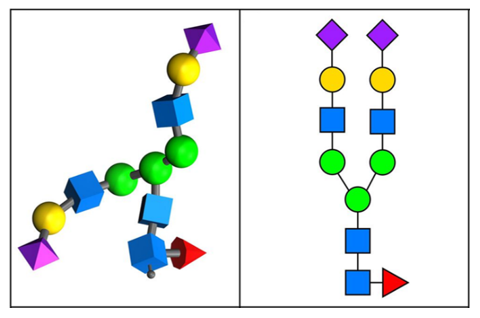
Glycans are complex chains of sugars that attach to proteins and lipids (fats) on cell surfaces. In many key biological functions, they act as barcodes, switches, and communication signals. The study of glycans is known as glycomics.
Glycans are especially fascinating because, unlike DNA and proteins, they are not assembled using molecular templates. Instead, networks of enzymes assemble glycans. These enzymes produce a wide range of branched molecules. This structural diversity has historically made glycans very challenging to study.
Advances in technology over the past few decades are quickly changing our ability to study glycans. High-resolution imaging and advanced chemical analysis now allow scientists to map glycan structures in remarkable detail. At the same time, machine learning and data analysis tools are helping researchers interpret the enormous variability in glycan patterns, enabling new breakthroughs in medicine, agriculture, and biotechnology.
Canada is playing a leading role in advancing glycomics through GlycoNet, a national research and commercialization network based at the University of Alberta. GlycoNet connects more than 200 researchers across the country and accelerates the translation of discoveries into health solutions for Canadians. The network also helps to train the next generation of glyco-scientists, strengthening Canada’s expertise in this emerging field.
Together, GlycoNet researchers are applying glycomics to major challenges in healthcare, agriculture, and environmental sustainability.
As scientists learn more about how glycans shape health and disease, new diagnostic techniques, vaccines, therapies, and technologies are emerging.
For instance, researchers at the University of British Columbia are working to break down blood-type barriers in transfusion and transplantation medicine. They are developing enzymes to remove or modify the specific sugars that determine different blood types, so that Type A or B blood can be converted into universally accepted Type O. This technology will help to create universal donor blood and organs.
Glycomics is also helping researchers better understand a wide range of diseases, from cancer to neurodegenerative conditions like Alzheimer’s and Parkinson’s disease. Cancer cells, for example, often display glycan patterns different from those of healthy cells. These modified glycans can influence how tumours grow, spread and avoid detection by the immune system. Studying these patterns is leading to new detection methods and treatments.
Beyond human health, researchers are applying glycomics to agricultural challenges. For example, scientists at the University of Montreal are developing a glycan-based vaccine to protect pigs from Streptococcus suis. This harmful type of bacteria affects the health of Canada’s swine (pork) sector. A vaccine would improve swine health while reducing the need for antibiotics.
Scientists at the University of Lethbridge are studying viruses that infect honeybees and the role glycans play in these infections. Their research could guide the development of antiviral strategies to protect honeybee populations, which are essential to maintaining healthy ecosystems and stable crop yields.
These are just a few examples of how glycomics is shaping a healthier future. As scientists continue to decode the complex language of glycans, their discoveries are opening new avenues for improved health, more resilient agriculture, and innovative solutions to global challenges.
Story republished from Let’s Talk Science